WHO REALLY CONTROLS THE SEMICONDUCTOR INDUSTRY?
The Hidden Companies That Make Modern Chips Possible
Why ASML, Zeiss, Synopsys, KLA, and other industry specialists may be even harder to replace than the world's largest foundries.
If you ask most people which company controls the semiconductor industry, the answer is usually the same: TSMC. It is an understandable answer. The world's most advanced chips, from Apple's processors and Nvidia's AI accelerators to AMD's CPUs, are manufactured primarily using TSMC's leading-edge process technologies.
But there is a more interesting question: Which company would be the hardest to replace if it disappeared tomorrow?
If TSMC vanished, the impact would be immediate and severe. Global chip shortages would worsen, product launches would be delayed, and billions of dollars of economic activity would be disrupted. Yet given enough money, engineering talent, and government support, competitors could eventually build additional manufacturing capacity.
The same cannot necessarily be said for companies such as ASML, Carl Zeiss SMT, KLA, Synopsys, or Tokyo Electron. These companies occupy highly specialized positions within the semiconductor ecosystem. Their products embody decades of scientific research, manufacturing expertise, intellectual property, and supplier relationships that cannot be replicated quickly.
The companies with the greatest strategic importance are not always the companies with the highest revenue. The semiconductor industry is therefore not controlled by a single company. It is supported by a network of technology leaders, each responsible for a critical layer of the modern chipmaking stack.
The Semiconductor Dependency Chain
The semiconductor ecosystem can be viewed as a series of interconnected layers. Each layer builds upon the previous one. A world-class foundry cannot manufacture a chip without design software. A chip design cannot become reality without manufacturing equipment. Manufacturing equipment cannot operate without specialized materials. And advanced AI systems cannot scale without advanced packaging.
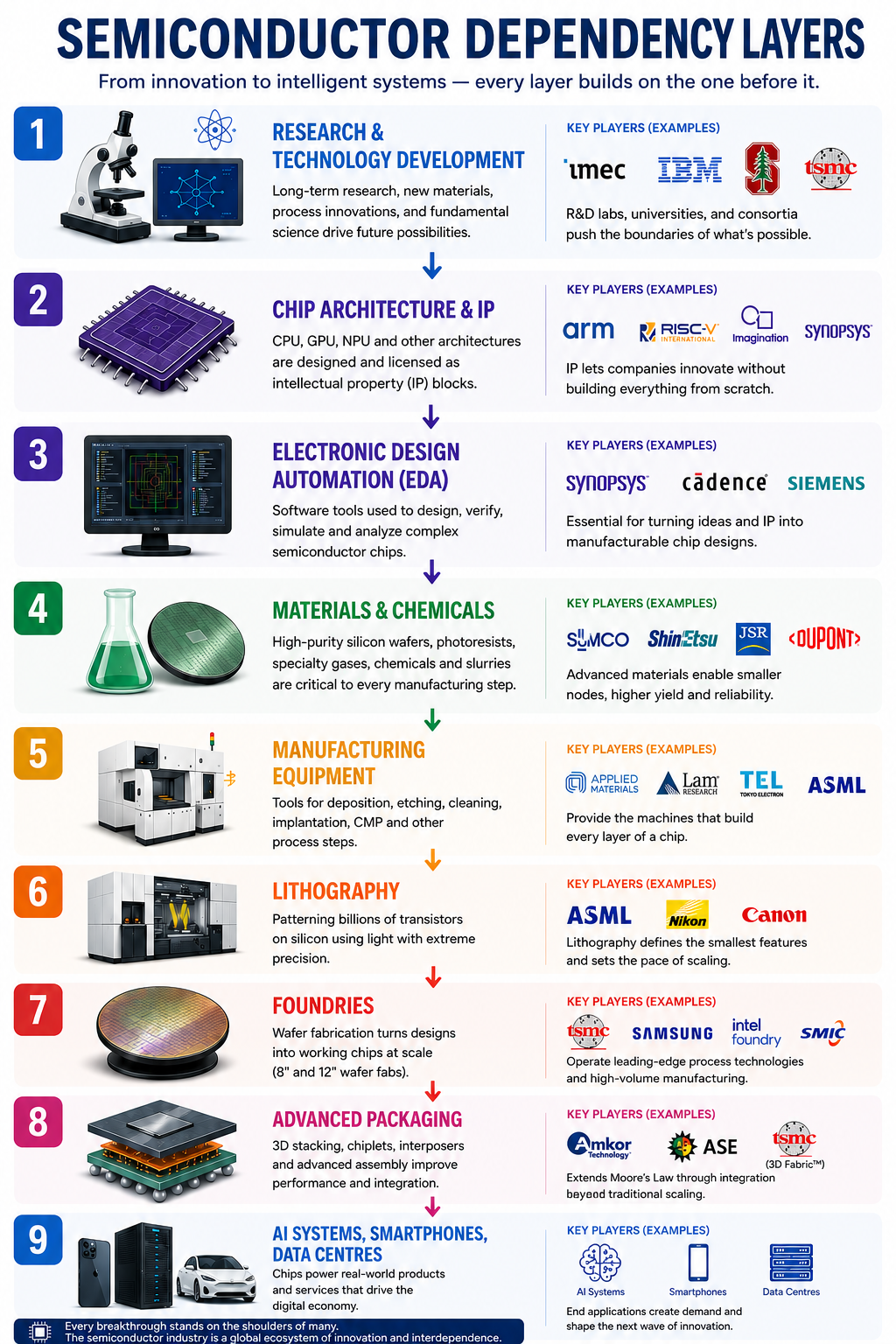
Figure 1: Semiconductor dependency chain with examples of key players at different layers.
The Companies That Would Be Hardest to Replace
Most rankings focus on:
- Revenue
- Market capitalization
- Profitability
- Market share
Our ranking uses a very different methodology.
Ranking Methodology
Companies are ranked according to:
- Replacement difficulty
- Scientific complexity
- Engineering barriers
- Supply-chain uniqueness
- Ecosystem dependence
- Time required to recreate equivalent capabilities
This is not a ranking of financial size but rather a ranking of strategic irreplaceability.
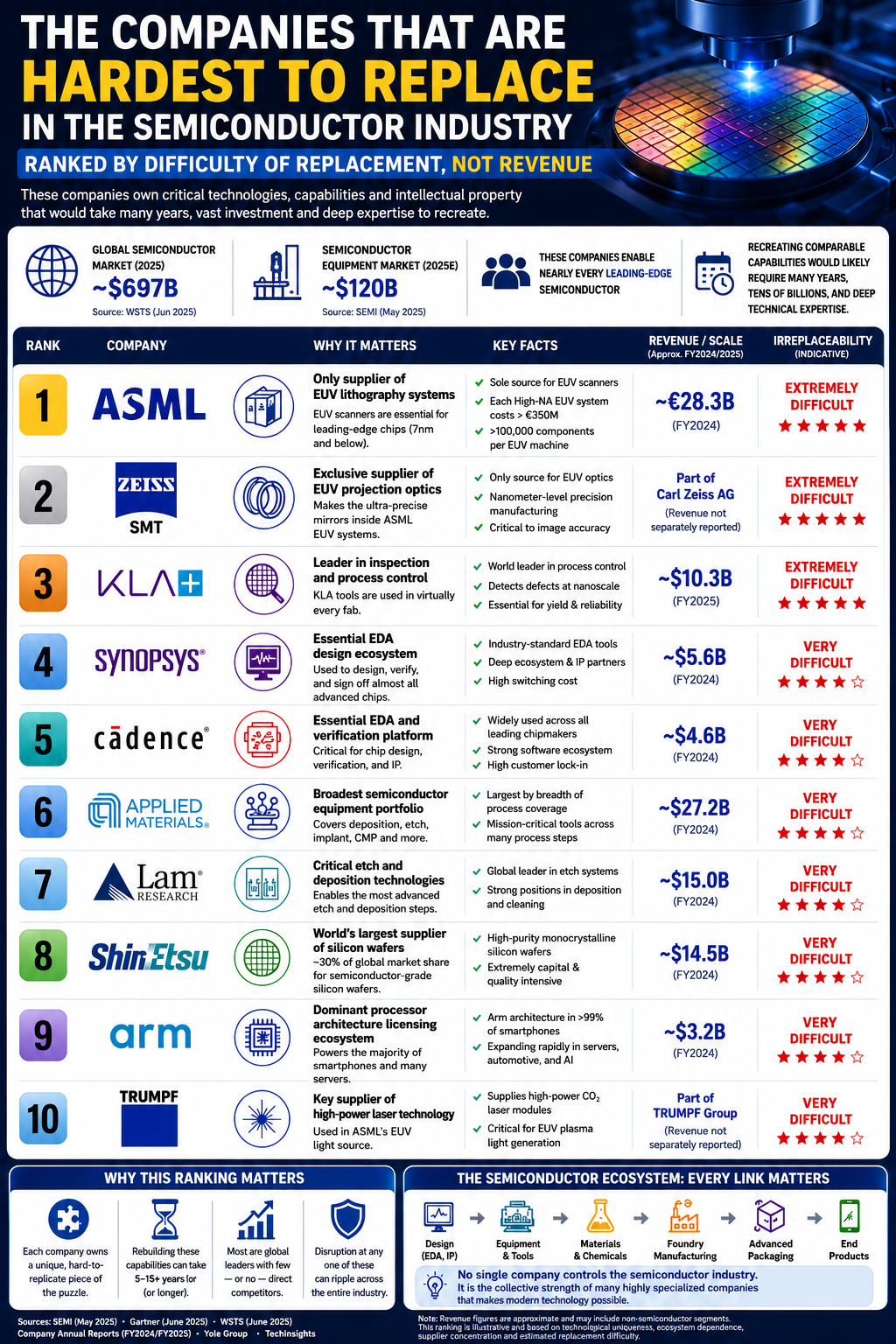
Figure 2: SemiComm's ranking of strategically irreplaceable semiconductor companies, based on replacement difficulty, scientific complexity, ecosystem dependence, and time required to recreate equivalent capabilities.
Layer 1: Research - Where Everything Begins
Long before a semiconductor reaches a data center, smartphone, or AI cluster, it begins in research laboratories. Everything depends on advances in physics, materials science, optics, chemistry, plasma engineering, and computational modeling.
Research institutions create the scientific breakthroughs that eventually become commercial technologies. For example:
- IMEC
- CEA-Leti
- Fraunhofer
- IBM Research
- Universities
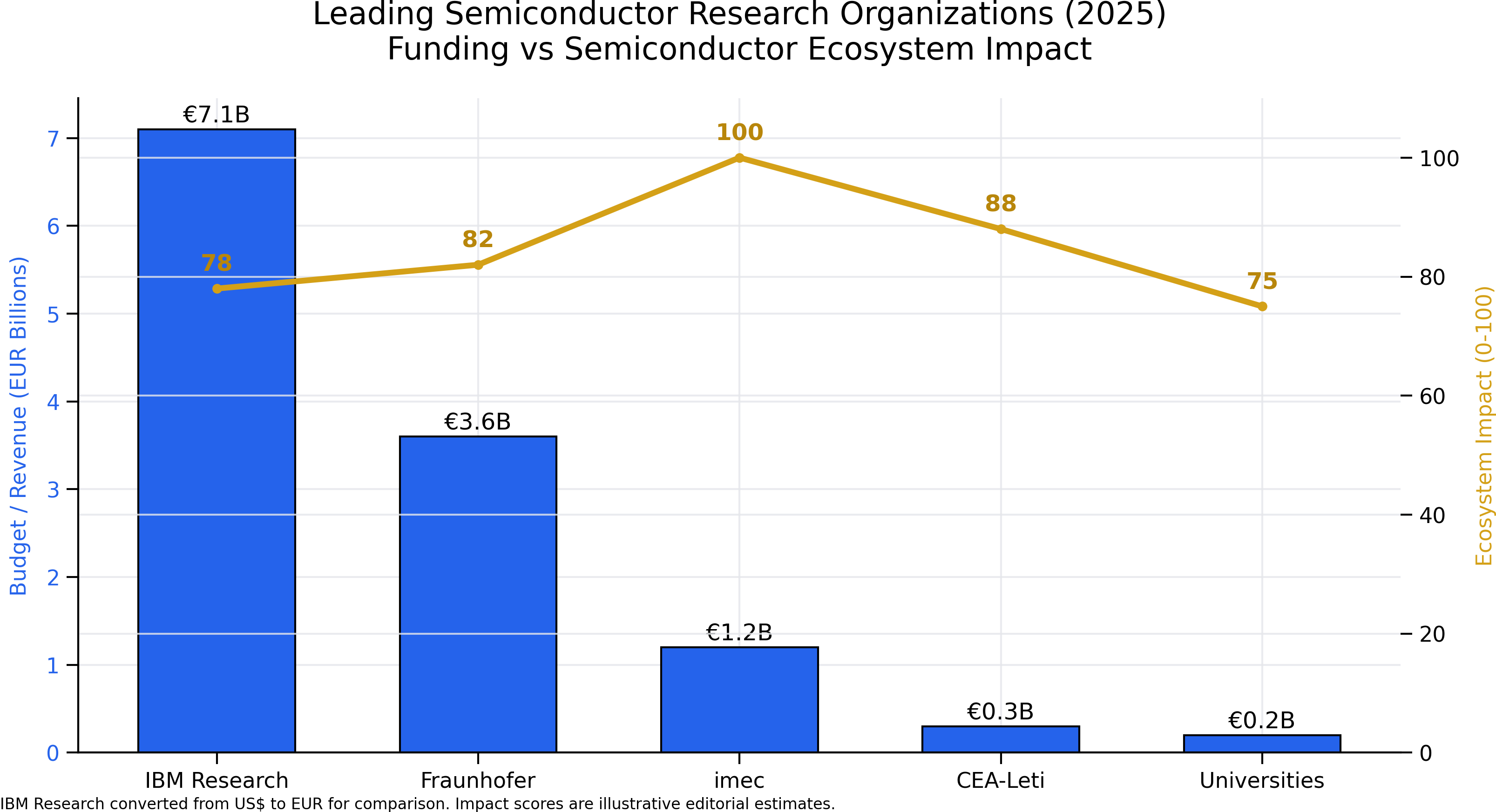
Figure 3: Funding and ecosystem impact of leading semiconductor research organizations in 2025, illustrating that influence on technological progress is not always proportional to research expenditure.
Those organizations genuinely shape the industry's future. No research means no industry.
Layer 2: EDA - The Software Behind Every Chip
Before a semiconductor can be manufactured, it must first be designed. Modern processors contain billions of transistors and countless possible interactions. Designing them manually is impossible.
EDA software enables engineers to create designs, verify functionality, optimize layouts, analyze timing, and prepare designs for manufacturing.
The dominant players are:
- Synopsys
- Cadence Design Systems
- Siemens EDA
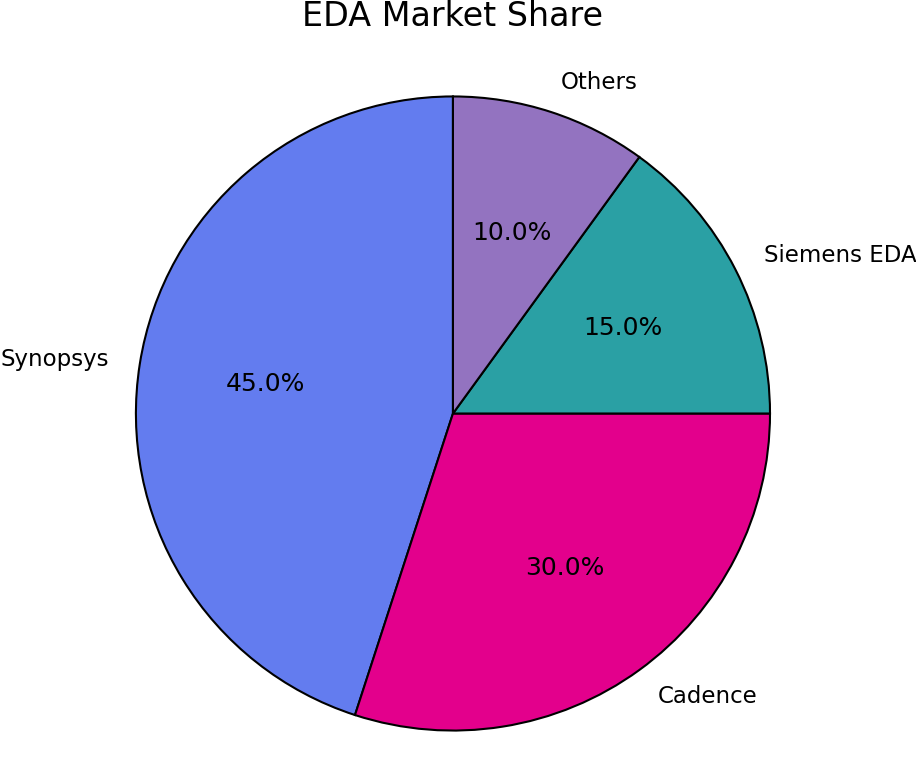
Figure 4: Global EDA Market Share (2025).
Without EDA software, no advanced chip can be designed. This is one of the least visible but most critical dependencies in the entire technology ecosystem.
Layer 3: IP and Architecture - The Invisible Foundation
Every chip begins with an architecture. Perhaps the best example is Arm Holdings. Arm designs CPU architectures that power most smartphones, embedded systems, automotive processors, and increasingly, cloud infrastructure. Arm manufactures no chips and yet billions of devices depend on its intellectual property.
This highlights an important principle: influence in semiconductors does not require owning a factory.
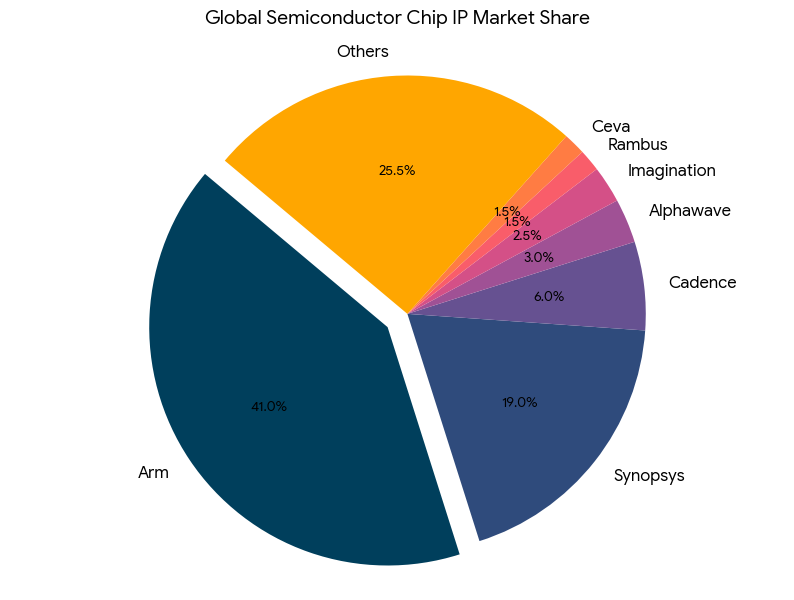
Figure 5: Global semiconductor chip IP market share in 2025.
Layer 4: Lithography - The Ultimate Bottleneck
The semiconductor industry has spent decades shrinking transistors. As dimensions reached the nanometer scale, traditional lithography approached its limits. The solution became: Extreme Ultraviolet (EUV) Lithography.
Today, only one company can manufacture EUV systems: ASML. ASML's EUV tools represent some of the most complex machines ever built by humans.
A single scanner contains more than 100,000 components, weighs approximately 180 tonnes, costs hundreds of millions of euros, requires months of installation, and depends on hundreds of suppliers.
ASML Quick Facts
- EUV Market Share: ~100%
- High-NA EUV Supplier: 100%
- Headquarters: Netherlands
- Critical Customers: TSMC, Samsung, Intel
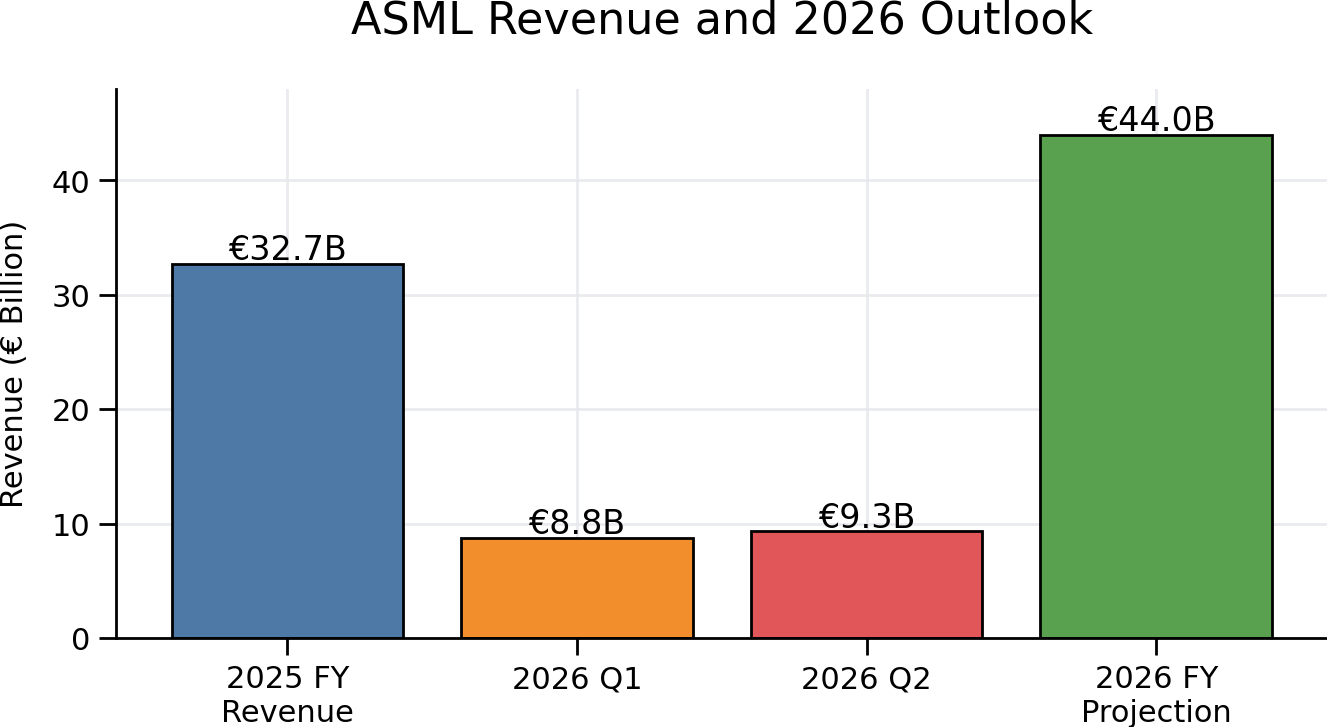
Figure 6: ASML's revenue in 2025 and projection for 2026.
Why ASML Cannot Exist Alone
A common misconception is that ASML created EUV independently. In reality, ASML serves as the integrator of one of the most sophisticated industrial ecosystems ever assembled. The most critical supplier is ZEISS SMT, which manufactures the ultra-precision mirrors used inside every EUV machine. These mirrors possess surface tolerances measured in fractions of nanometers.
Without ZEISS, there is no EUV lithography. This is why ZEISS ranks second in our irreplaceability ranking. Some other key suppliers for the tool are shown in Figure 7.
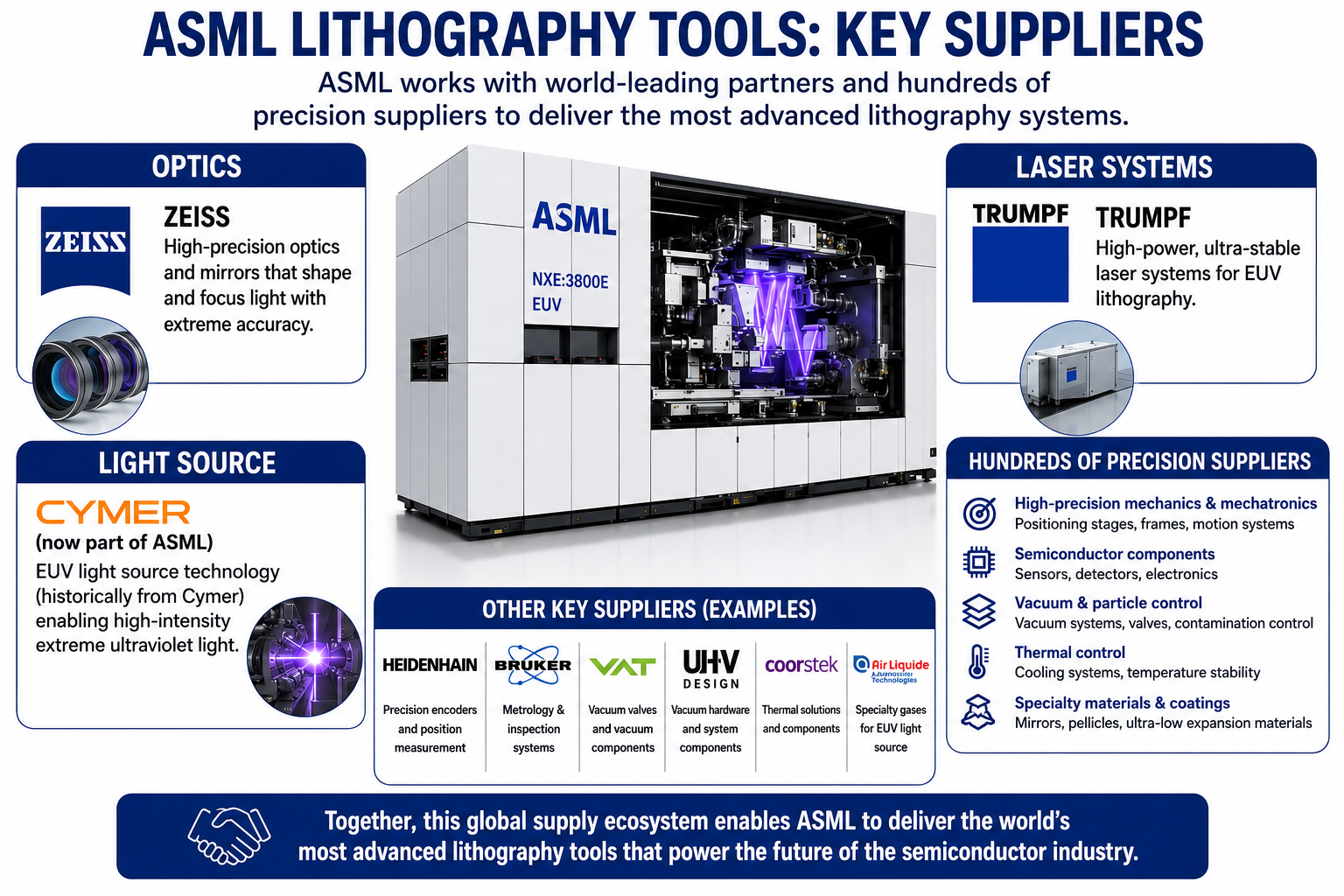
Figure 7: Key suppliers for ASML's EUV lithography tool.
Layer 5: Materials - The Hidden Bottleneck
The semiconductor industry depends not only on silicon.
Advanced manufacturing requires:
- Photoresists
- Specialty gases
- CMP slurries
- Advanced substrates
- Ultra-pure chemicals
- Semiconductor-grade wafers
Many of these markets are highly concentrated. One of the most critical companies is Shin-Etsu Chemical. The company is among the world's largest suppliers of semiconductor-grade silicon wafers. Without wafers, there is no manufacturing and consequently, no chips.
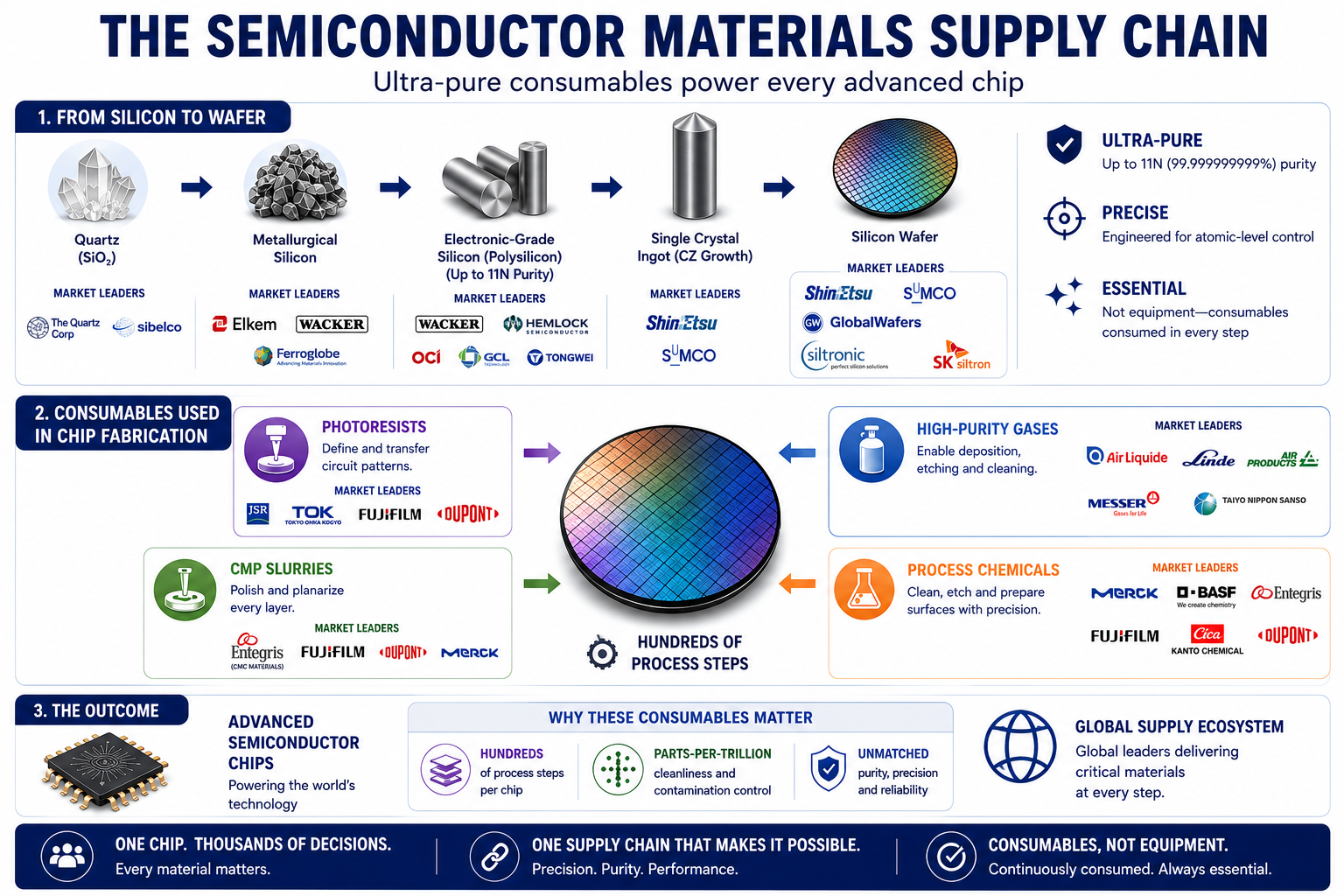
Figure 8: Critical raw materials used for semiconductor manufacturing.
Layer 6: The Companies That Actually Build the Factory
Lithography alone does not manufacture a chip. A single wafer passes through hundreds of processing steps. These include multiple rounds of deposition, etching, cleaning, ion implantation, inspection, and metrology.
The dominant equipment suppliers include:
- Applied Materials: Materials engineering leader.
- KLA: Inspection and process control leader.
- Tokyo Electron: Critical process equipment supplier.
- Lam Research: Advanced etch specialist.
- ASM International: ALD technology pioneer.
Together, these companies provide the tools required to physically create modern transistors. A fab without them is simply a very expensive building.
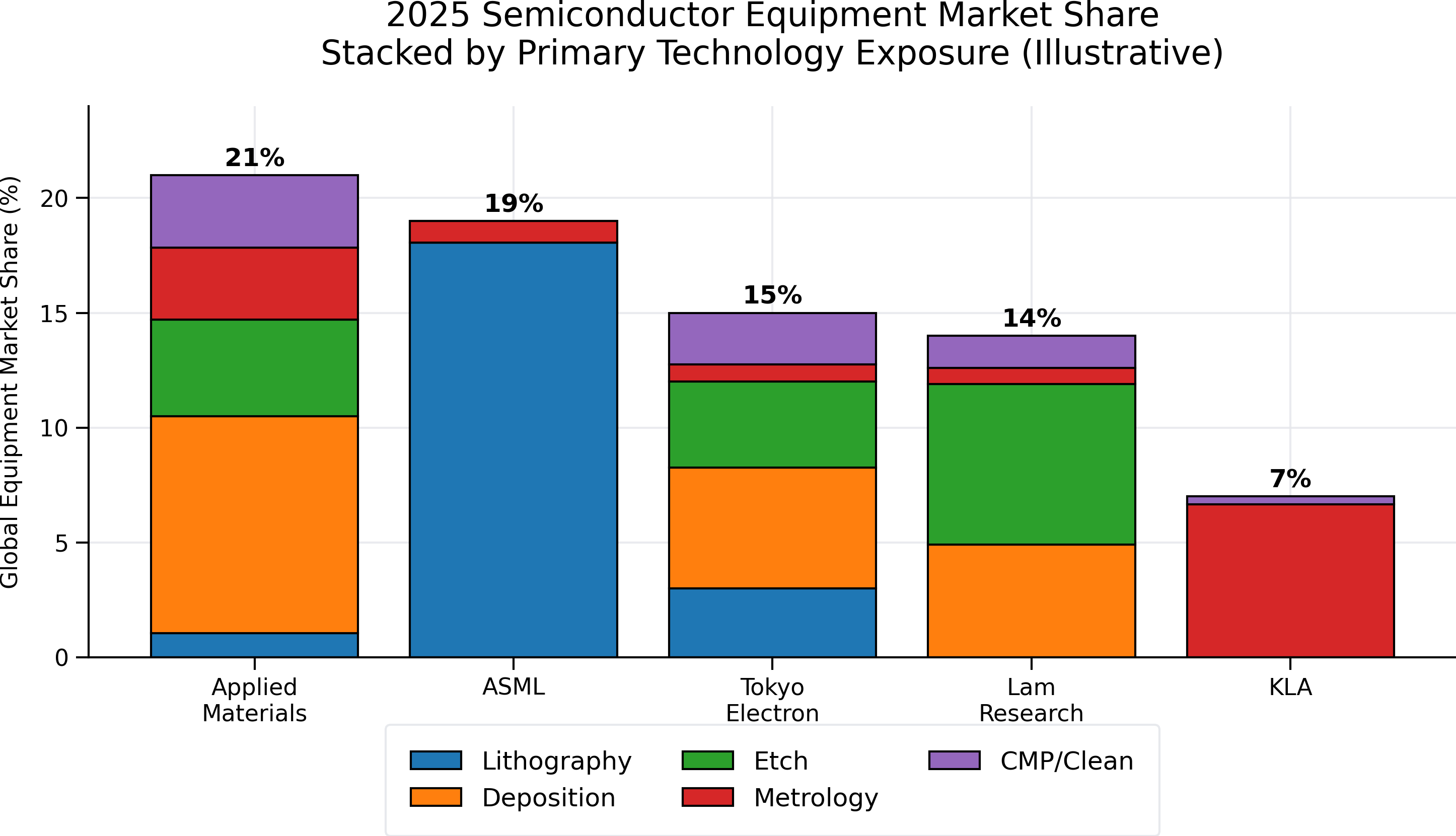
Figure 9: Semiconductor equipment manufacturer market share for different tools in 2025.
Layer 7: Foundries - The Manufacturing Backbone
Foundries transform designs into physical silicon. The major players include:
- TSMC
- Samsung Foundry
- Intel Foundry
- GlobalFoundries
- UMC
- SMIC
Among them, TSMC leads in advanced manufacturing. The company manufactures chips for Apple, Nvidia, AMD, Broadcom, Qualcomm, and numerous AI companies.
TSMC Quick Facts
- World's largest pure-play foundry
- Leading-edge process leader
- Critical supplier for advanced AI hardware
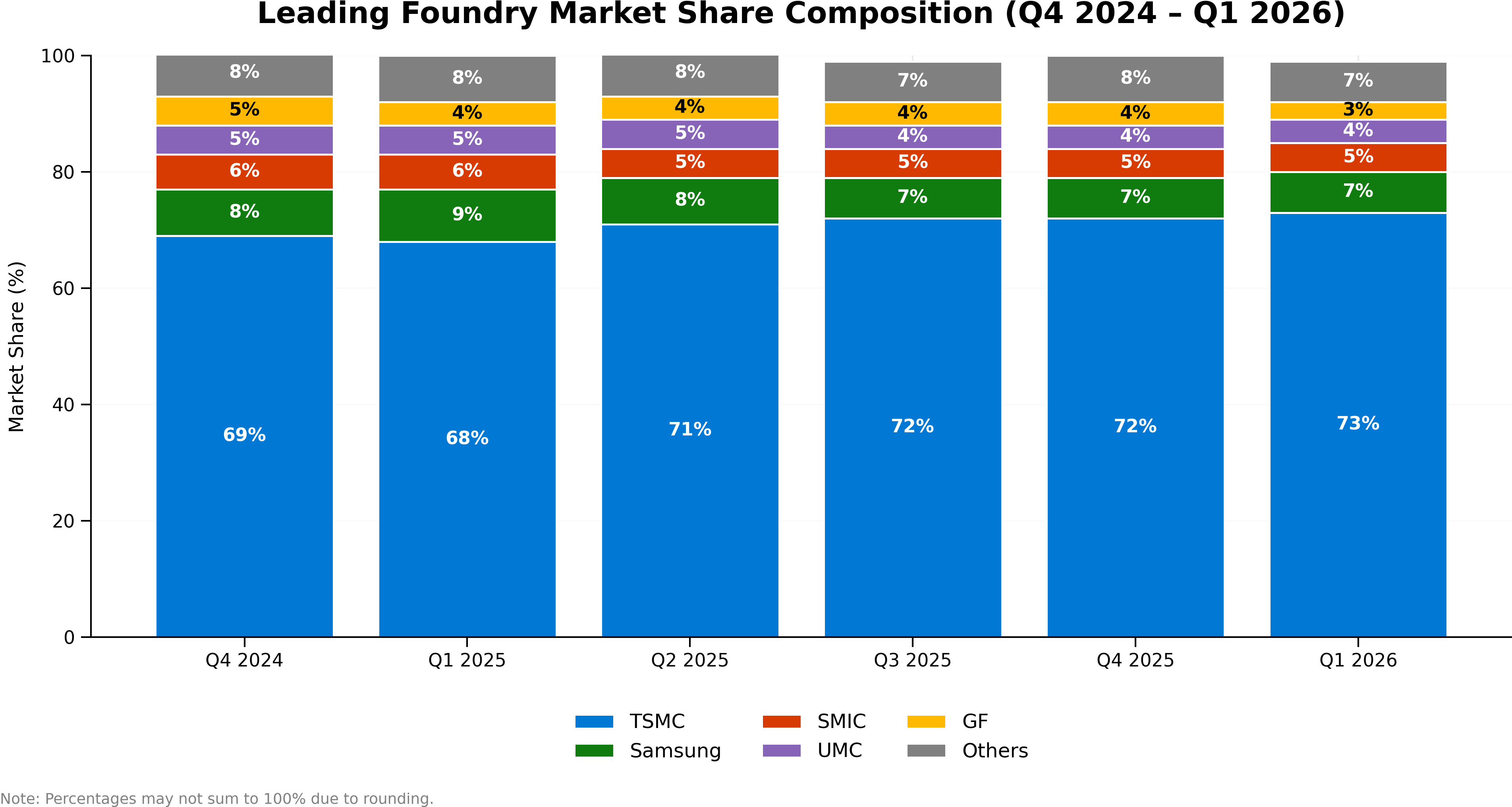
Figure 10: Global semiconductor foundry market share, 2025-2026.
Layer 8: Advanced Packaging - The AI Era's New Bottleneck
Transistor scaling is no longer the only path to higher performance. Modern AI processors increasingly depend on chiplets, HBM memory, 2.5D packaging, and 3D integration.
Industry leaders include:
- ASE Technology
- Amkor
- JCET
- TSMC CoWoS
For many AI systems, packaging has become as important as transistor scaling itself.
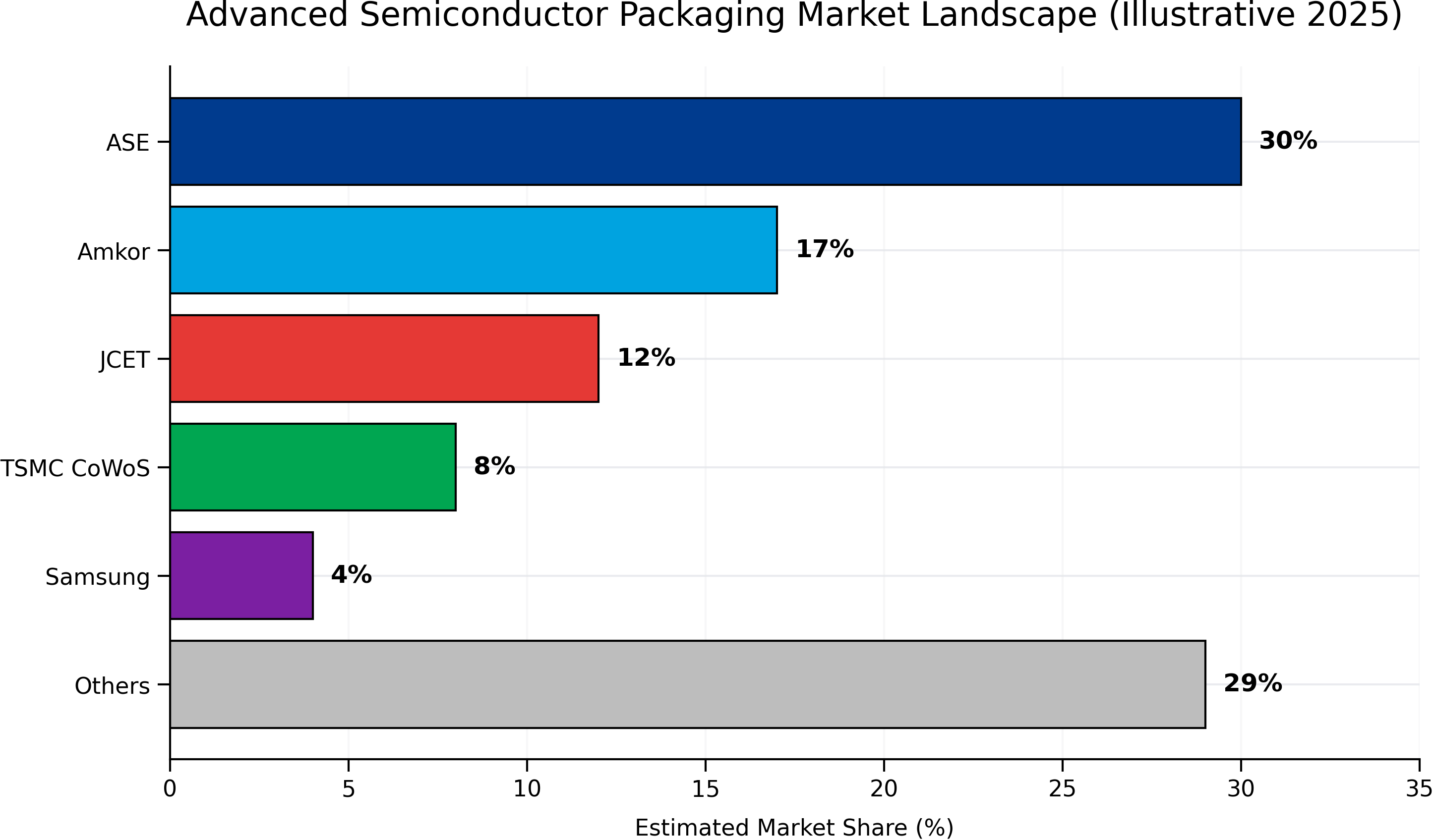
Figure 11: Estimated market share for OSATs providing advanced packaging service in 2025.
What Happens If One Company Disappears?
This thought experiment reveals the industry's true bottlenecks.
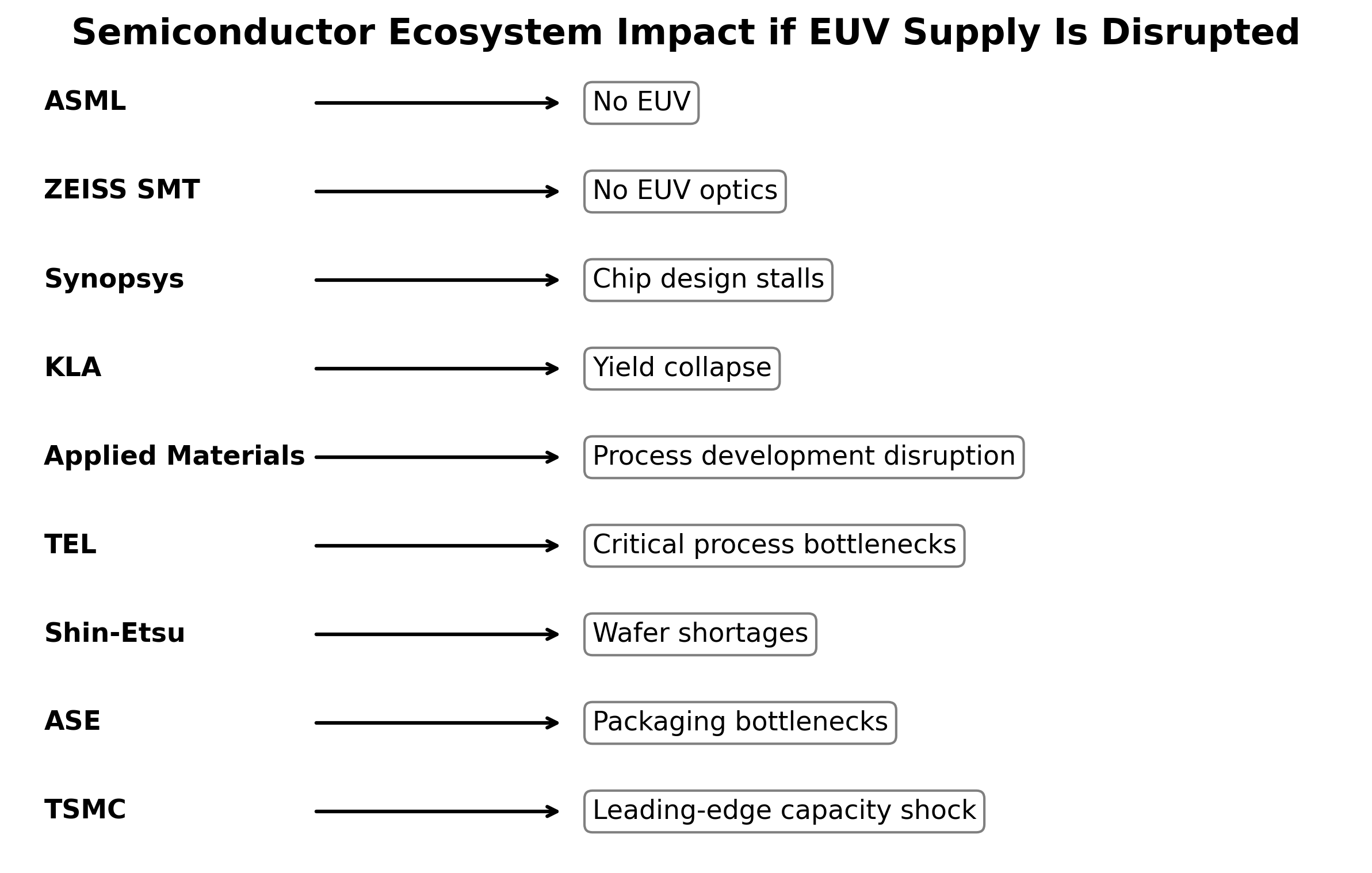
WHO REALLY CONTROLS THE SEMICONDUCTOR INDUSTRY?
Perhaps the question itself is flawed. No single company controls semiconductors. Instead, the industry operates as an interconnected network of specialized leaders, each controlling a crucial layer of the technology stack.
- Foundries manufacture chips.
- EDA companies enable design.
- Equipment companies build the tools.
- Materials companies provide the foundation.
- Packaging companies enable AI scaling.
- Lithography companies define technological progress itself.
The remarkable reality is that some of the most strategically important companies in the world remain almost invisible to the public. If judged by market capitalization, one answer emerges. If judged by replacement difficulty, a very different hierarchy appears.
That hierarchy includes:
- ASML
- ZEISS SMT
- TSMC
- Applied Materials
- KLA
- Tokyo Electron
- Lam Research
- Synopsys
- Cadence
- Shin-Etsu Chemical
- ASM International
These are the companies that quietly sit at the foundation of the modern digital economy. The next time you use AI, stream a video, open a smartphone app, or access a cloud service, remember: The technology behind that experience was not created by a single company.
It was built through decades of scientific progress and enabled by a small group of extraordinarily difficult-to-replace companies.
So, instead of asking who really controls the semiconductor industry, a better question may be:
Which company would be impossible to replace before the world ran out of time?
That question reveals where the industry's true power lies.
Disclaimer
The views, rankings, and opinions expressed in this article are the author's own and are intended for informational purposes only. They do not represent the views, positions, or opinions of any company, organization, or employer. The ranking of semiconductor companies is a subjective assessment based on publicly available information and the author's analysis of strategic importance, replacement difficulty, and ecosystem dependence.
References
- ASML - EUV lithography technology, semiconductor manufacturing ecosystem, and annual reports. https://www.asml.com/
- Semiconductor Industry Association (SIA) - Global semiconductor industry trends, supply chain analysis, and market data. https://www.semiconductors.org/
- SEMI - Semiconductor equipment market data, World Fab Forecast, and manufacturing ecosystem analysis. https://www.semi.org/
- TSMC - Advanced semiconductor manufacturing, foundry leadership, and advanced packaging technologies. https://www.tsmc.com/
- TrendForce Semiconductor Research - Semiconductor market share data, foundry analysis, and industry forecasts. https://www.trendforce.com/
Comments and reactions