Intel Develops World's Thinnest GaN Chiplet for AI Power Delivery
Intel Foundry demonstrates an ultra-thin GaN chiplet that combines power transistors with digital control to improve efficiency for AI-era systems.
Published: July 27, 2026
As AI chips continue to demand more power, efficient power delivery is becoming a critical challenge. Intel Foundry has announced a breakthrough with the world's thinnest gallium nitride (GaN) chiplet, built on a 300 mm GaN-on-silicon wafer with a silicon substrate thinned to just 19 um.
The chiplet integrates GaN power transistors and silicon-based digital control circuitry, enabling more compact, efficient power management for next-generation AI, HPC, and data center applications.
Why it matters
GaN offers higher efficiency, faster switching speeds, and greater power density than conventional silicon power devices. As AI systems scale beyond kilowatt-level power consumption, innovations in power delivery will become just as important as advances in compute performance.
Semicomm Insight: The future of AI is not just about smaller transistors; it is also about smarter power delivery. Intel's latest demonstration highlights how GaN, chiplets, and advanced packaging are becoming key enablers of next-generation semiconductor systems.
Reference: Intel Foundry, World's Thinnest GaN Chiplet for AI Power Delivery (2026): https://community.intel.com/t5/Blogs/Intel-Foundry/Systems-Foundry-for-the-AI-Era/Intel-Foundry-Achieves-Breakthrough-with-World-s-Thinnest-GaN/post/1743389
Rapidus vs TSMC: The Real Story Behind the 40% Cheaper 2nm Wafer Claim
Japan's ambitious foundry challenger is making rapid progress, but the real battle will be decided by yield, scale, and manufacturing excellence — not just wafer pricing.
Published: July 10, 2026
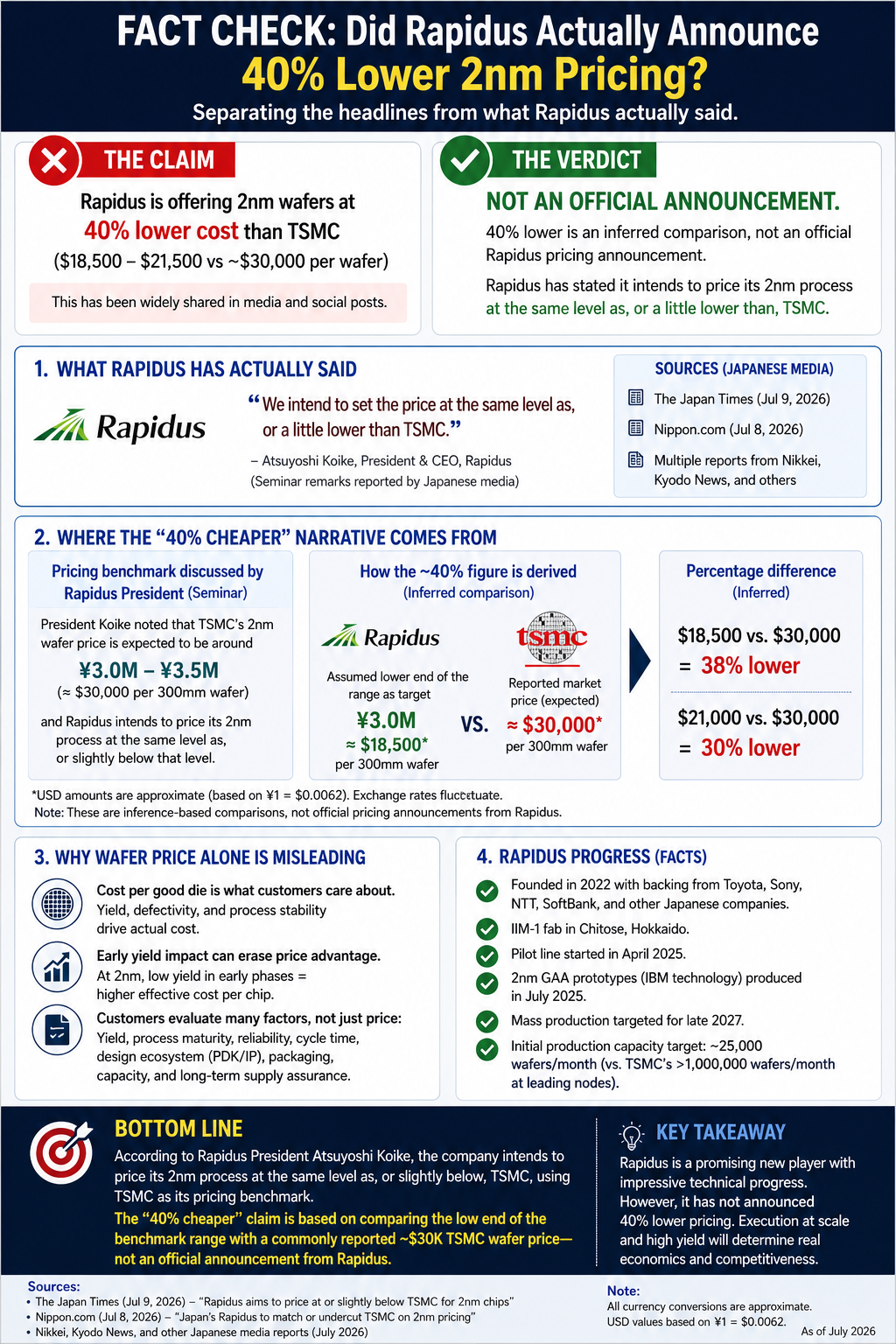
The semiconductor industry has been closely watching Japan's Rapidus after reports suggested that its upcoming 2nm wafers could be priced significantly lower than TSMC's. However, the widely shared claim that Rapidus will offer 40% cheaper 2nm wafers is not based on an official pricing announcement. Rapidus President and CEO Atsuyoshi Koike has stated that the company's goal is to price its 2nm process at a level comparable to, or slightly below, TSMC, rather than offering a fixed discount percentage.
The bigger story goes beyond wafer pricing. At the 2nm node, the key measure of competitiveness is cost per good die, which depends on yield, process maturity, manufacturing scale, reliability, and advanced packaging capabilities. Rapidus has made significant progress, including demonstrating 2nm gate-all-around transistor technology and advancing its IIM-1 pilot production facility in Japan. While the company represents an important new player in the advanced foundry market, the real test will be whether it can achieve high-volume manufacturing and compete with the production efficiency and ecosystem strength of established leaders like TSMC.
Reference: Jiji Press / Nippon.com — Rapidus plans 2nm pricing at the same level as, or slightly below, TSMC pricing, The Japan Times — reporting on Atsuyoshi Koike's comments regarding Rapidus 2nm pricing strategy, Rapidus official announcement — 2nm GAA transistor prototyping milestone at IIM-1
Semiconductor Sales Surge on AI-Driven Demand
Global sales hit $120.6 billion in May 2026, with the Americas leading the growth
Published: July 7, 2026
Global semiconductor sales reached $120.6 billion in May 2026, up 104.1% year-over-year and 9.2% month-over-month, marking one of the strongest growth periods the industry has seen in recent years. Every major region posted gains, but the Americas stood out with a remarkable 132.2% YoY increase, followed by Asia Pacific (+118.9%) and China (+88.8%), showing just how broad the current demand cycle has become.
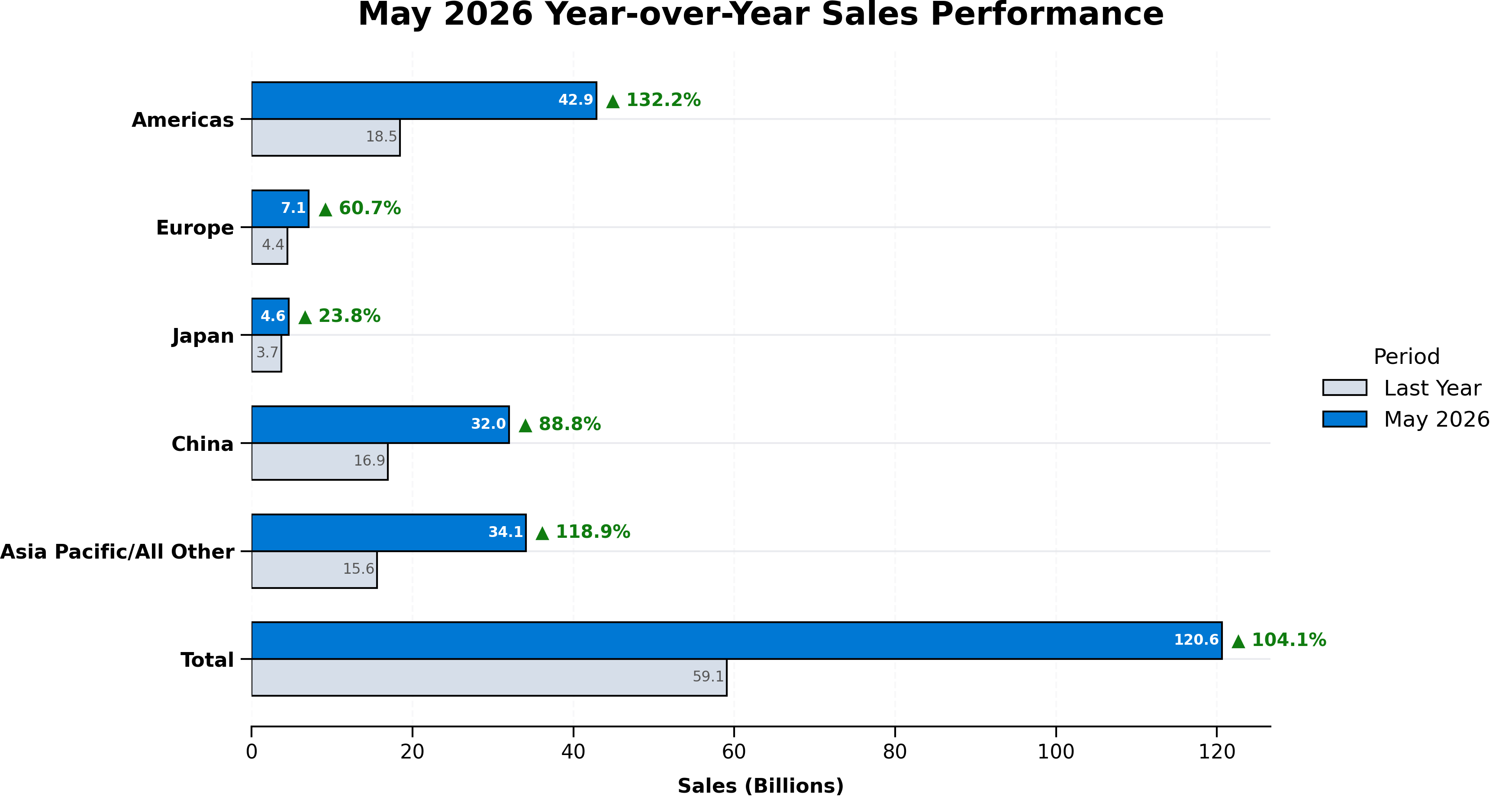
The main driver behind this surge is the rapid build-out of AI infrastructure. Heavy investment in AI data centers is boosting demand not just for GPUs, but also for high-bandwidth memory (HBM), networking chips, power semiconductors, and advanced packaging. At the same time, the comparison is against a softer 2025 base, when the industry was still working through inventory corrections and weaker consumer demand. Taken together, this suggests the current growth is more than a short-term rebound and points to a deeper shift, with AI now becoming the key force shaping the semiconductor market.
Reference: https://www.wsts.org/, https://www.semiconductors.org/
What Gary Jiang's Appointment Says About Terafab
The Intel veteran who could help turn Terafab's ambitions into reality.
Published: July 2, 2026
When Terafab announced Intel veteran Gary Jiang as one of its first publicly identified leadership hires, it sent a clear message about the company's priorities. Jiang spent nearly 18 years at Intel, rising to Factory Manager, where he led factory startup, equipment installation, technology transfer, and high-volume manufacturing of advanced process technologies, including Intel's 18A node. Before Intel, he built expertise in semiconductor inspection and metrology at Rudolph Technologies, giving him a rare combination of process engineering and manufacturing leadership.
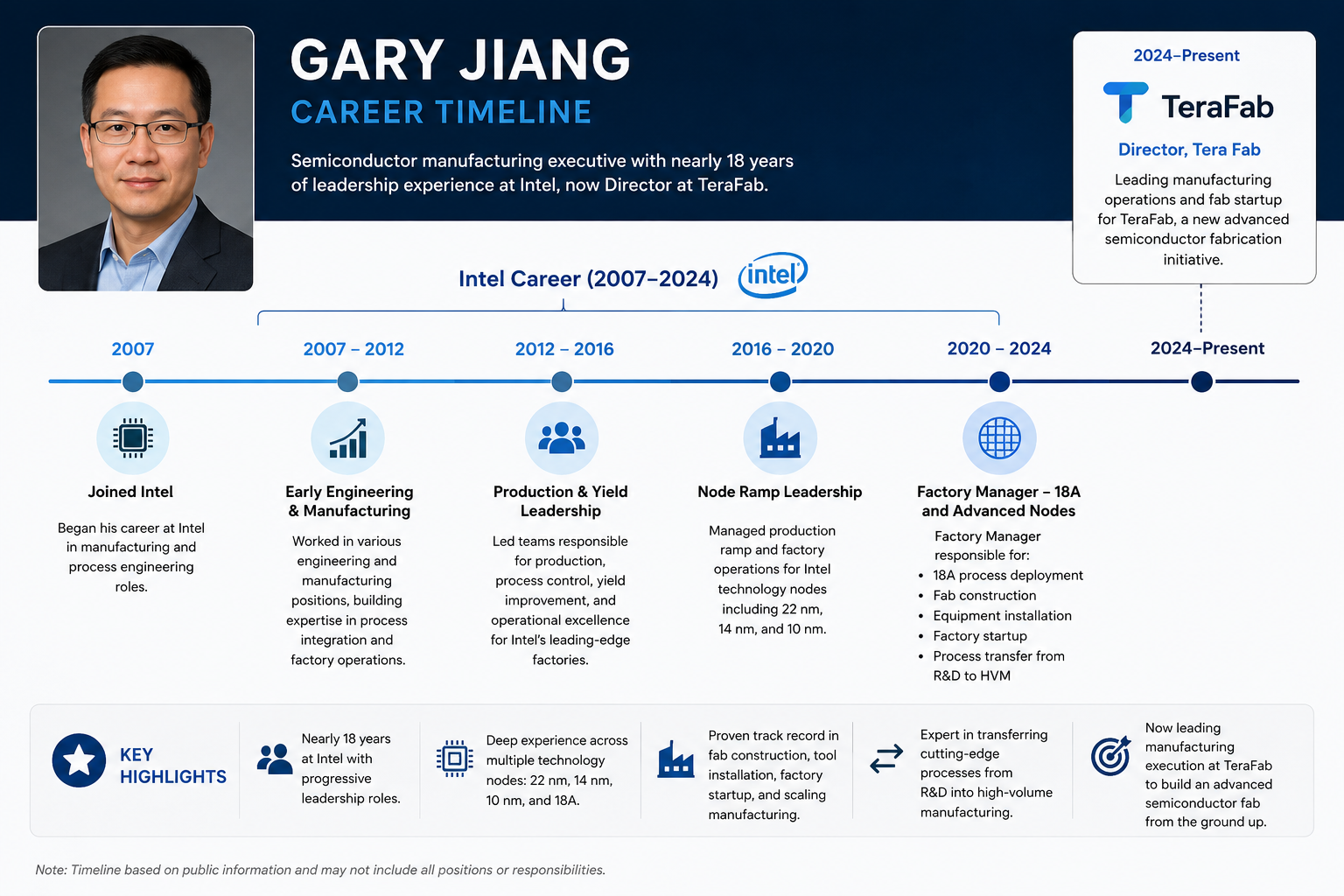
His appointment is particularly noteworthy as Terafab is reportedly planning to adopt Intel's 14A-MI manufacturing technology for its future semiconductor production. While the company has disclosed few technical details, recruiting an executive with first-hand experience in Intel's manufacturing ecosystem could significantly strengthen its ability to transfer advanced process technology into high-volume production. In the semiconductor industry, designing a leading-edge chip is only half the challenge-success ultimately depends on building a fab that can manufacture it reliably and at scale. Jiang's track record suggests Terafab is placing manufacturing excellence at the center of its strategy.
AI's Next Gold Rush: It's Not Just About GPUs
Samsung and SK Hynix's reported US$1.3 trillion investment signals a new era for the entire semiconductor ecosystem.
Published: July 1, 2026
When most people think about AI, they think about powerful GPUs. But behind every AI breakthrough is an entire semiconductor supply chain working to keep up. Samsung and SK Hynix's reported US$1.3 trillion investment shows the race is now about much more than computing power.
Memory, advanced packaging, manufacturing capacity, and materials are now central to AI scale-up. The companies that invest across the semiconductor value chain, from EUV lithography and photoresists to process engineering and supply chain resilience, will shape the next chapter of innovation.
Could Infineon's new Smart Power Fab in Dresden help shape the future of Europe?
Published: June 28, 2026
From electric vehicles and AI to renewable energy, advanced semiconductors are at the heart of tomorrow's technologies. Discover how Infineon's new Smart Power Fab in Dresden is strengthening Europe's semiconductor industry and helping power the innovations of the next decade.
Beyond manufacturing advanced chips, the facility is expected to create around 1,000 highly skilled jobs, strengthen Europe's supply chain resilience, and support a more sustainable semiconductor ecosystem. Find out why this €5 billion investment is considered a milestone for both the European chip industry and the technologies that will define our future.
Read the full article
Why Apple Can Charge More Than Dell and Lenovo
Published: June 28, 2026
Apple's latest laptop price increases have left many wondering: is this simply another premium price hike, or are there real cost pressures behind it? While AI-driven demand has pushed memory prices higher across the industry, that's only part of the picture.
In the article below, we look at what is really driving Apple's pricing and compare its strategy with Dell and Lenovo to understand why Apple continues to command a premium beyond the cost of the hardware itself.
Read the full article
AI-driven semiconductor demand
Accelerators, memory, and advanced packaging are shifting investment priorities across the sector.
Regional manufacturing resilience
Geopolitical and trade pressures continue to reshape sourcing and production decisions.
Next generation materials
Materials innovation remains a key differentiator in performance, power, and yield.