INDIA'S SEMICONDUCTOR ECOSYSTEM
Building an industry from the ground up
Every country wants semiconductors, but very few attempt to build an entire semiconductor ecosystem. Designing chips is difficult, and manufacturing them is even harder. But connecting design, materials, fabrication, packaging, equipment, talent, and supply chains into a functioning industrial system is the biggest challenge.
Unlike many industries, semiconductors cannot be built around a single factory. Success depends on an ecosystem where every stage supports the next. That is precisely what India is trying to build.
For decades, India has become one of the world's leading centres for semiconductor design. Thousands of Indian engineers have helped develop processors, automotive chips, communications ICs, and AI accelerators that are used worldwide. Yet despite this design strength, the physical chips themselves were almost entirely manufactured overseas.
Today, this is beginning to change.
In December 2021, the Government of India established the India Semiconductor Mission (ISM), backed by a ₹76,000 crore (approximately US$10 billion) incentive programme to accelerate domestic semiconductor manufacturing. The objective is simple in principle, but difficult in practice: "Transform India from a global chip-design powerhouse into a country capable of manufacturing semiconductors at scale."
From design powerhouse to manufacturing ambition
India's semiconductor story began much earlier than ISM. Its first manufacturing efforts date back to the Semiconductor Complex Limited (SCL) in the 1980s. While SCL served important strategic applications, India never developed the commercial manufacturing ecosystem seen in Taiwan, South Korea or, later, China.
Instead, India found another strength. Following economic liberalisation in the 1990s, companies including Texas Instruments, Intel, Qualcomm, AMD, NVIDIA and Broadcom established major engineering and design centres across Bengaluru, Hyderabad and Noida. Over the next three decades, India became one of the world's largest semiconductor design hubs, supplying engineering talent to nearly every major chip company.
Manufacturing, however, largely remained abroad. The turning point came during the global chip shortage. COVID-19 exposed just how fragile semiconductor supply chains had become. At the same time, geopolitical tensions underscored the strategic risks of relying on a handful of manufacturing locations. Semiconductors were no longer just an economic issue. They had become a matter of national resilience.
A market growing at an extraordinary speed
India's semiconductor market is expected to expand from approximately US$38 billion in 2023 to US$100-110 billion by 2030, driven by demand from:
- Artificial intelligence
- Electric vehicles
- Consumer electronics
- Telecommunications
- Industrial automation
- Renewable energy
- Data centres
Demand alone, however, does not create a semiconductor industry. Manufacturing capability does.
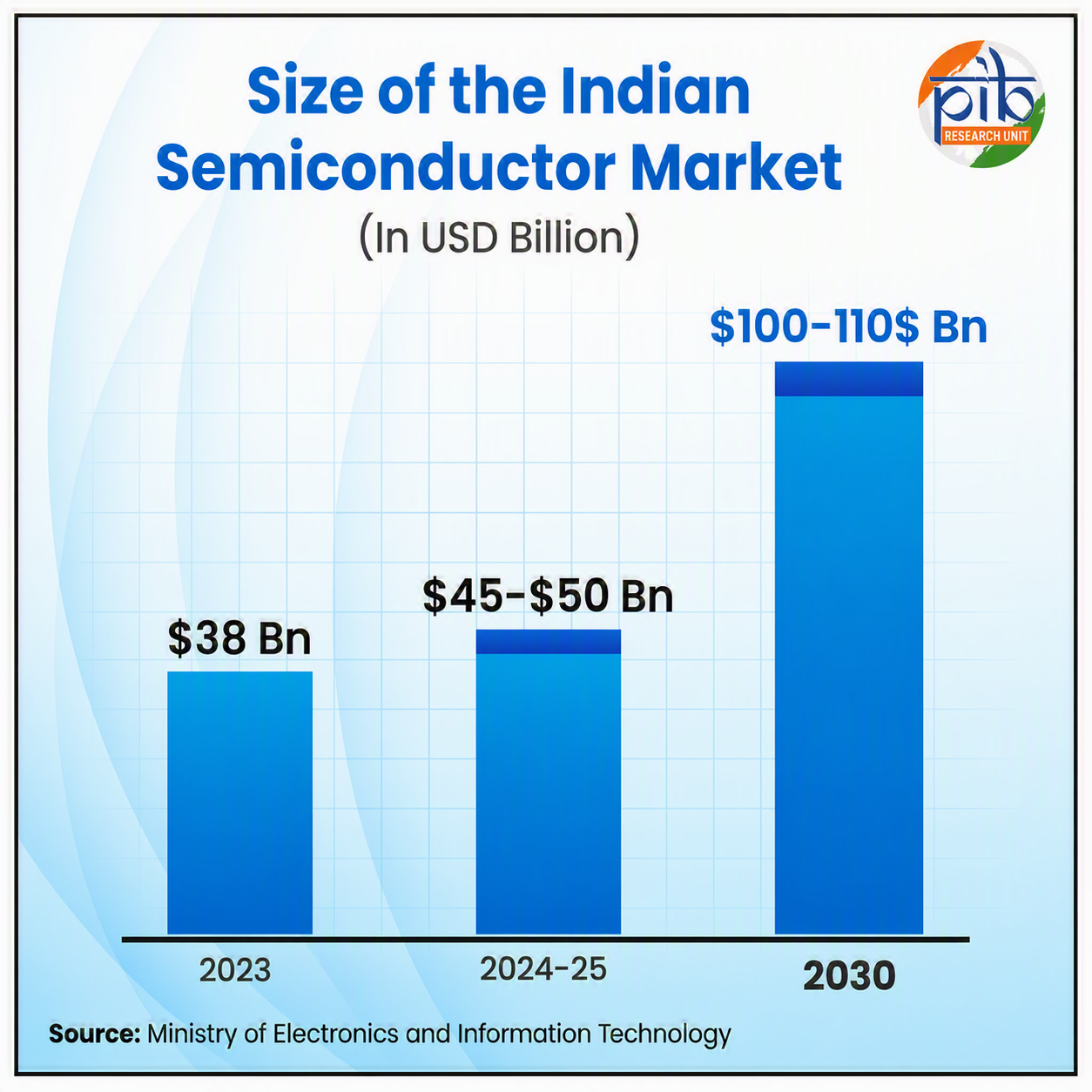
Figure 1: Growth of India's semiconductor market.
Building the manufacturing base
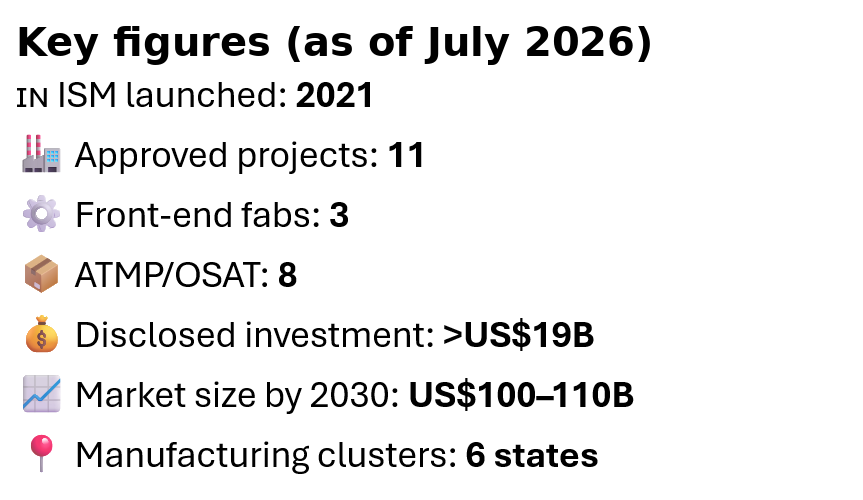
As of July 2026, India has approved 11 semiconductor manufacturing projects, comprising three front-end fabrication facilities and eight back-end Assembly, Testing, Marking, and Packing (ATMP) / Outsourced Semiconductor Assembly and Test (OSAT) facilities.
Together, these projects cover silicon fabrication, silicon carbide (SiC), gallium nitride (GaN), memory packaging, advanced packaging, heterogeneous integration, and power semiconductors.
Table: List of semiconductor projects approved (Update: July 2026).
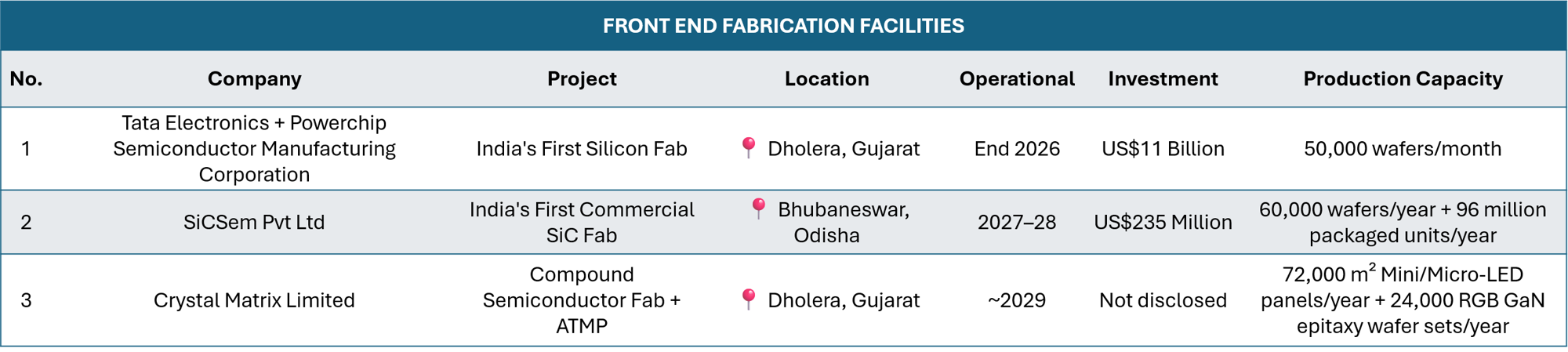
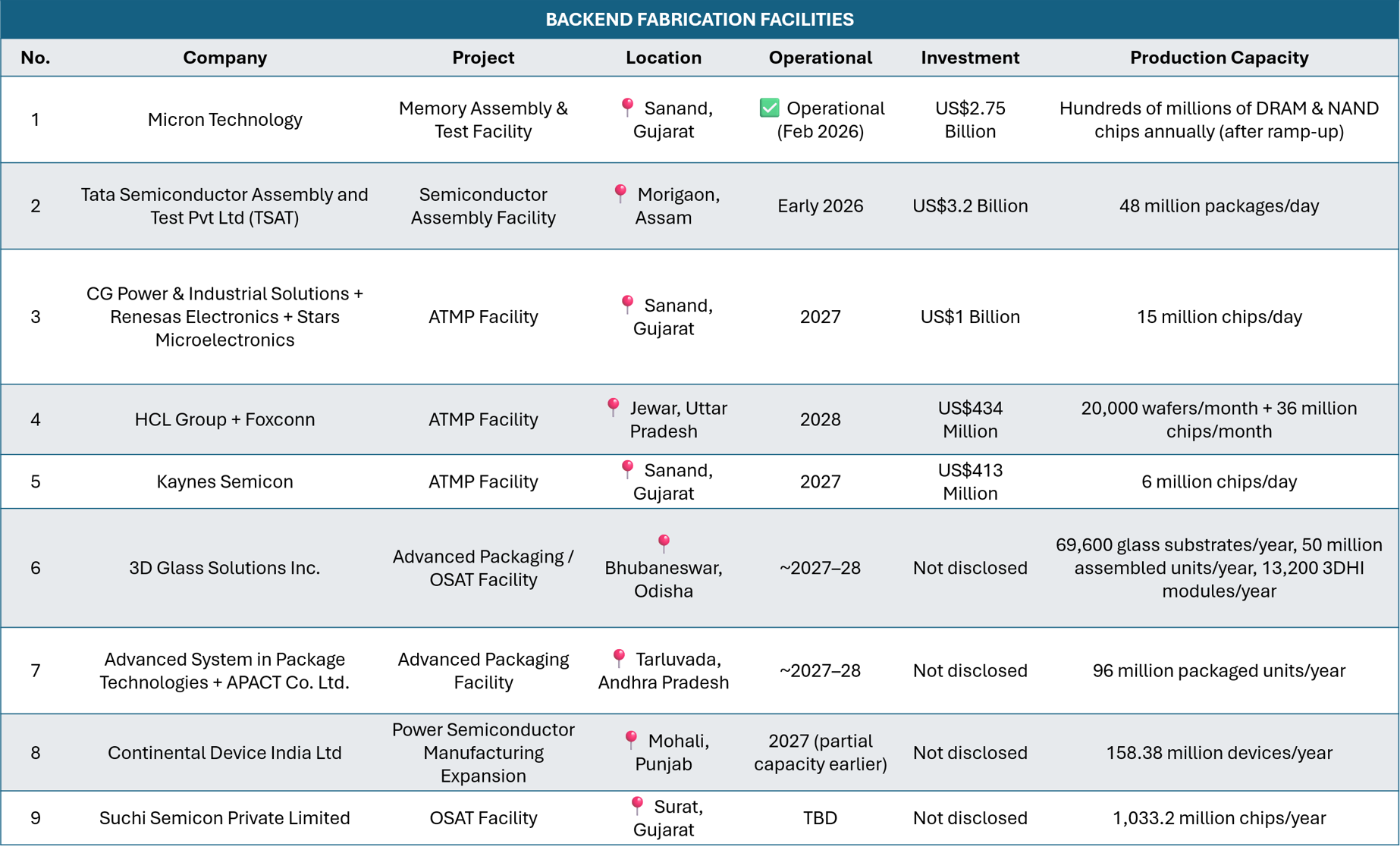
The disclosed investments exceed US$19 billion, including US$11.2+ billion in front-end fabrication and US$7.8+ billion in assembly, testing, and advanced packaging.
Rather than focusing exclusively on wafer fabrication, India is investing across multiple stages of the semiconductor value chain, reducing risk while building broader industrial capability.
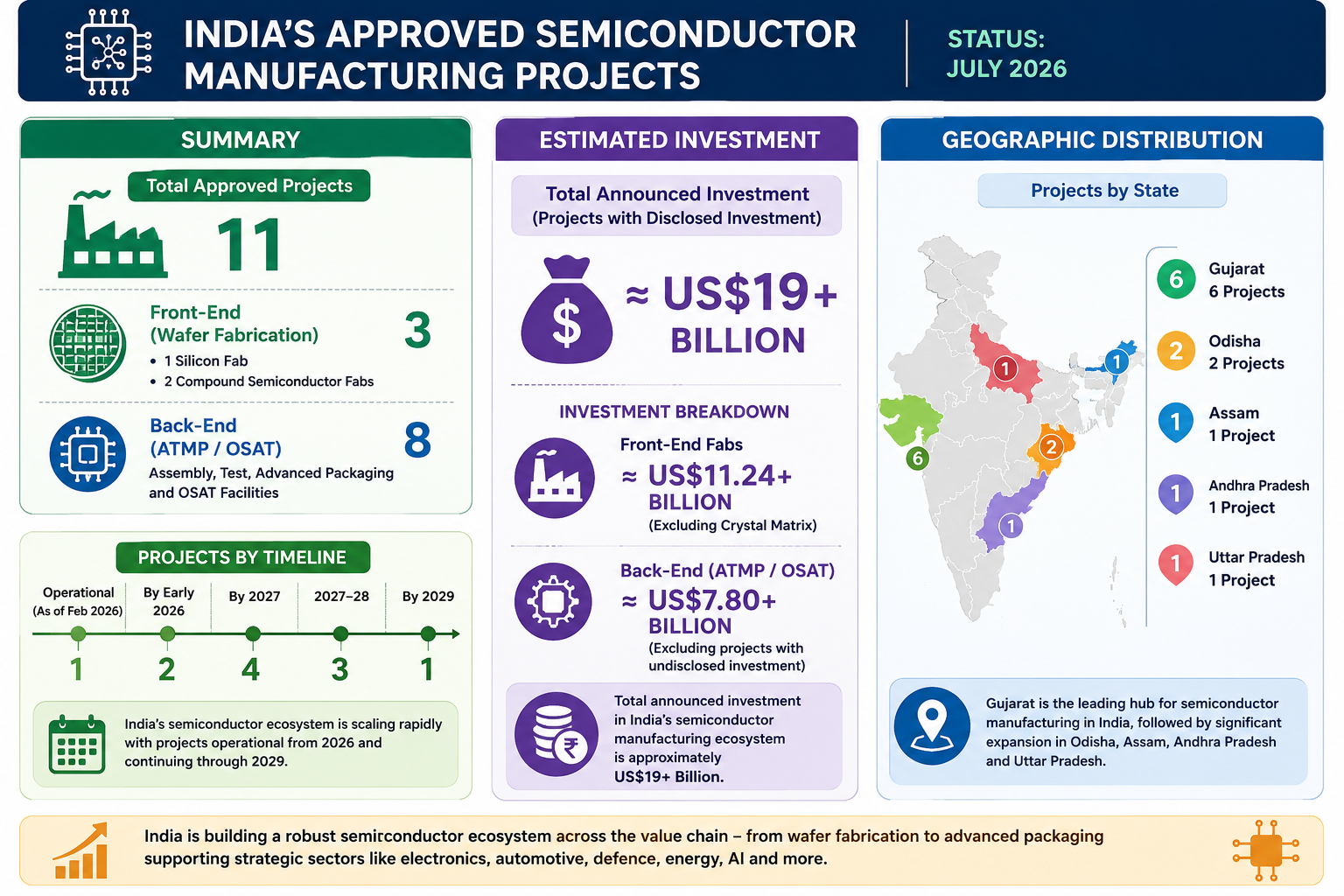
Figure 2: Overview of India's Semiconductor Manufacturing Ecosystem (July 2026) - summary of approved front-end and back-end projects, estimated investments exceeding US$19B, and geographic distribution across key semiconductor hubs in India.
A distributed manufacturing strategy
India is not creating one semiconductor city. It is building several specialized clusters across the nation.
- Gujarat is emerging as the country's manufacturing anchor, hosting India's first silicon fab alongside multiple ATMP facilities.
- Assam is becoming a centre for advanced packaging.
- Odisha is developing silicon carbide, compound semiconductors, and heterogeneous integration.
- Uttar Pradesh is expanding assembly and packaging.
- Andhra Pradesh is strengthening OSAT capabilities.
- Punjab continues expanding power semiconductor manufacturing.
Rather than competing with one another, these states are gradually forming different parts of the same industrial system.
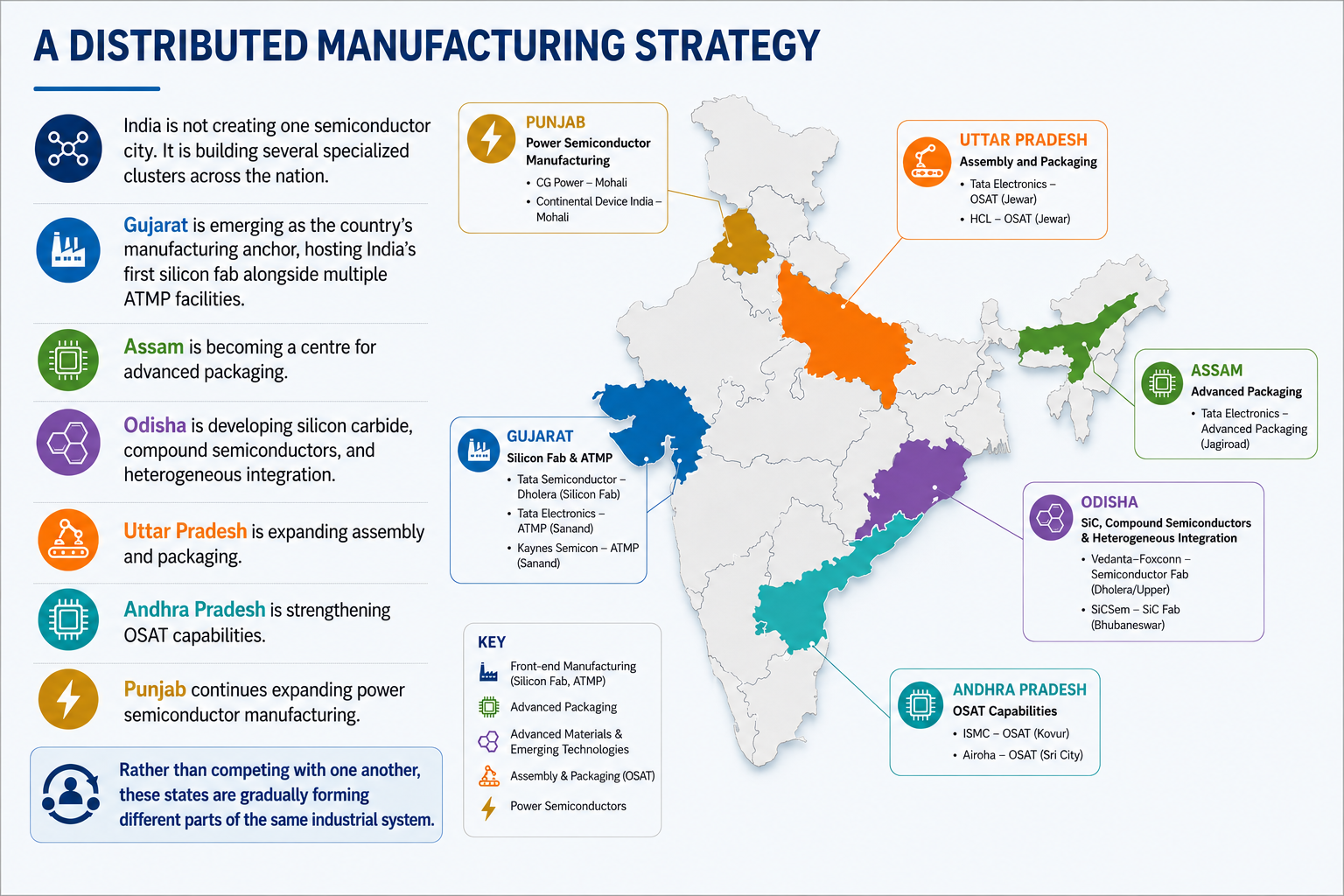
Figure 3: Semiconductor development in India with key regions and major projects.
More than fabs
A semiconductor ecosystem extends far beyond wafer fabrication. It includes:
- Chip design & IP
- Materials and specialty chemicals
- Semiconductor equipment
- Wafer fabrication
- ATMP / OSAT
- Electronics manufacturing
- Final products
Historically, India has excelled in design. Today, it is expanding across nearly every remaining stage of the value chain. While advanced lithography and leading-edge manufacturing remain dominated by global players, India is steadily strengthening domestic capabilities in fabrication, packaging, materials, and downstream electronics manufacturing.
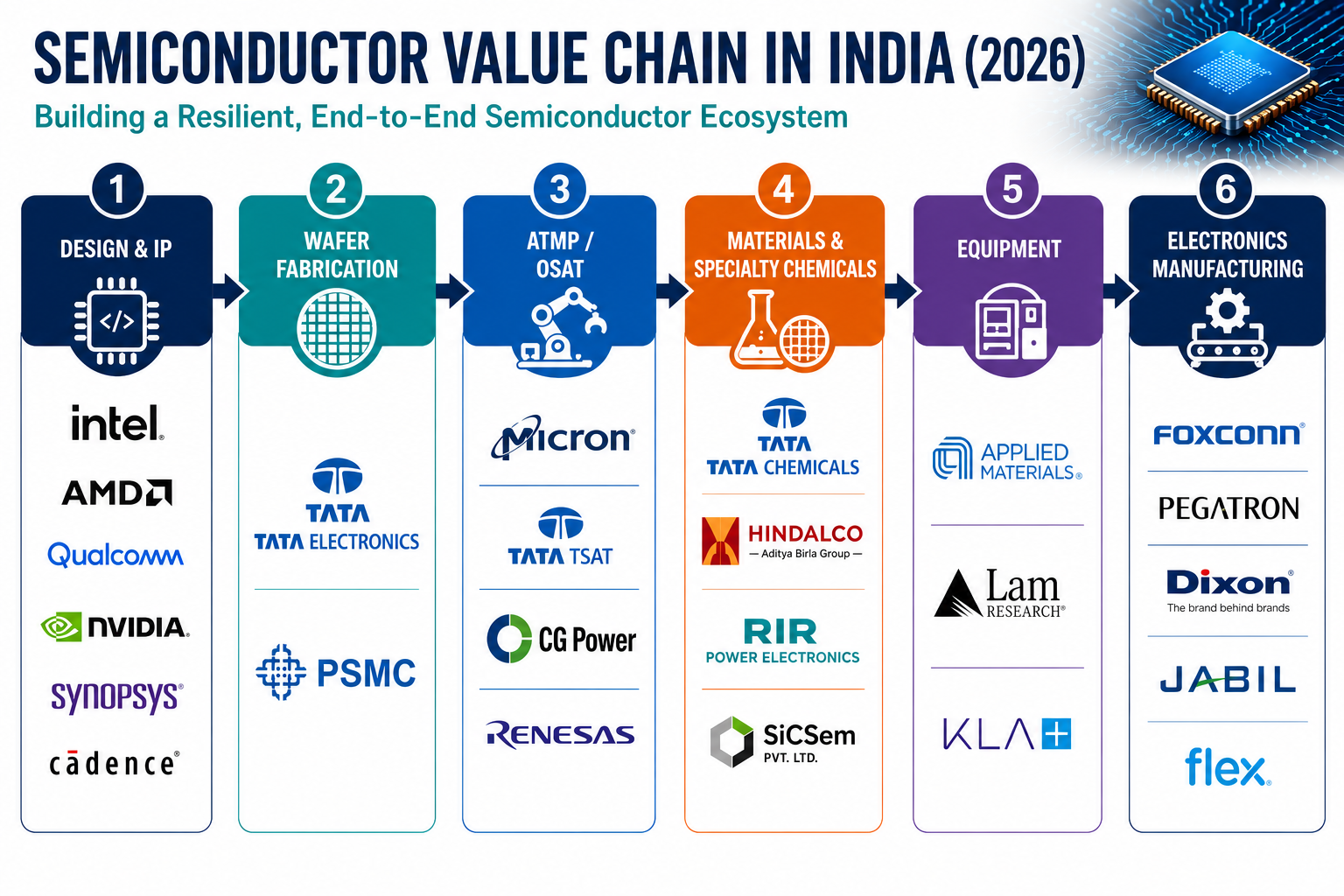
Figure 4: Semiconductor value chain in India (2026).
Building through partnerships
Infrastructure alone does not create an ecosystem. Talent, research, and international collaboration are equally important.
Since 2023, India has established semiconductor partnerships with Japan, the European Union, Singapore, Purdue University, IBM, and Lam Research in collaboration with the Indian Institute of Science (IISc), and AMSL and Fujifilm, more recently.
Together, these partnerships strengthen supply-chain resilience, workforce development, research collaboration and technology transfer, critical ingredients for a competitive semiconductor industry. A complete timeline of key policy, partnership, and ecosystem milestones is provided in Figure 5.
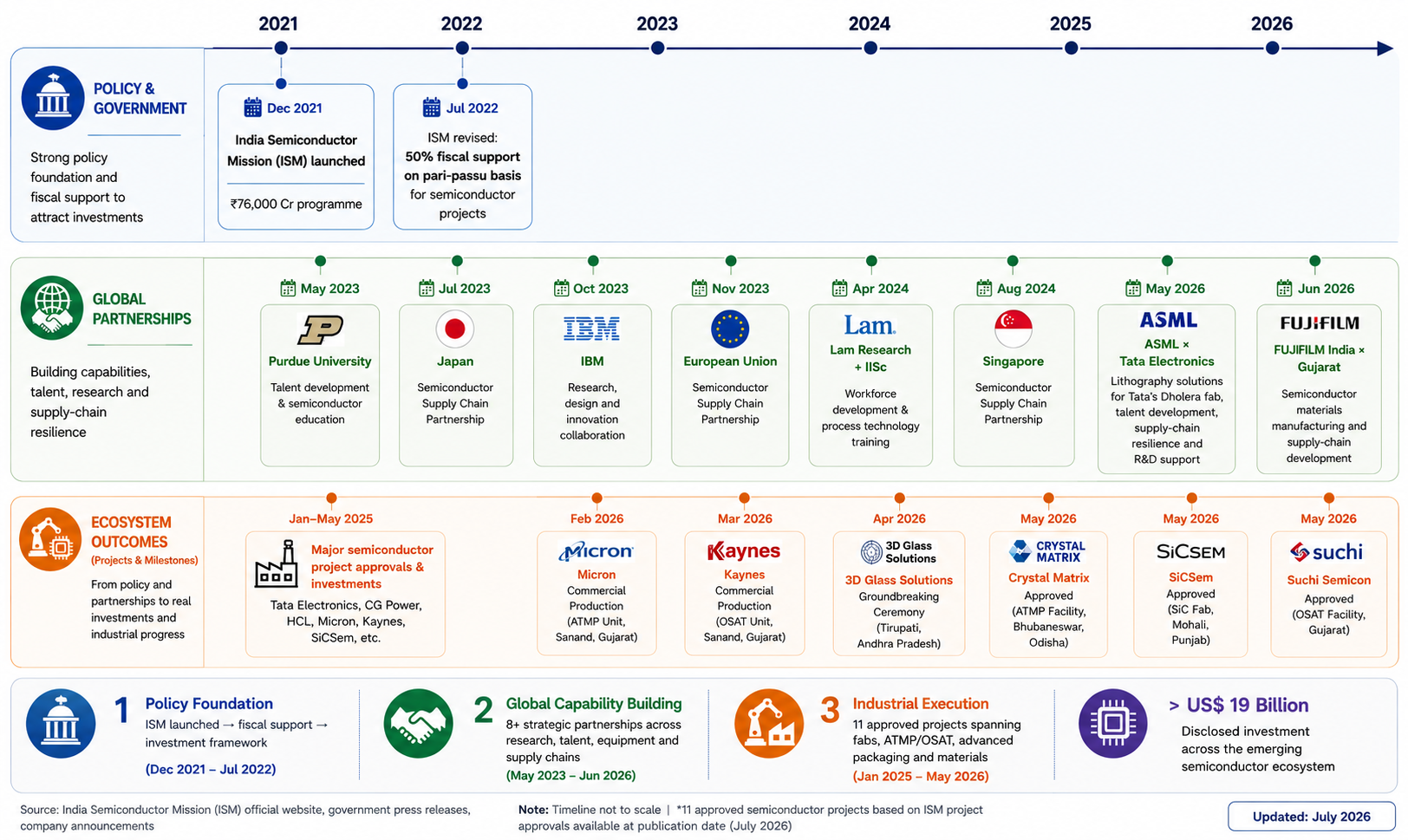
Figure 5: Key policy, partnership, and ecosystem milestones shaping India's semiconductor industry (December 2021-July 2026).
SemiComm's Opinion
Building the railway while the trains are already running
One analogy kept coming back to us while researching India's semiconductor strategy.
Building a semiconductor ecosystem feels remarkably similar to building a railway network. You cannot simply build one station and expect trains to run. Someone has to design the locomotives, and someone has to build them. Tracks need to be laid, signals must communicate, and maintenance depots are needed to keep the system moving. Only when every piece works together do the passengers experience a seamless journey.
India's semiconductor ecosystem is much the same. Bengaluru designs many of the "trains." Gujarat is beginning to build them. Assam prepares them for operation through packaging and testing. Odisha supplies advanced materials and compound semiconductor technologies. Uttar Pradesh is extending the network with new manufacturing capacity.
No single fab, packaging plant, or policy announcement creates a semiconductor industry. The real achievement comes when every part of the system connects into a resilient, self-sustaining ecosystem.
India has not finished building its railway. But for the first time, the tracks are beginning to connect.
Comments and reactions